Navigation Projects

A rock structure coming out of the mouth of a river is pictured with a crane and a bulldozer on top.

Oregon Coastal Projects

Text/HTML

The U.S. Army Corps of Engineers does not maintain recreation facilities at these locations. Please stay off the jetties as they are hazardous and not intended for recreational use. Nearby and/or adjacent recreational facilities fall under the jurisdiction of private, local or state agencies. Learn more about jetties and why they are unsuitable for recreation at Understanding Coastal Jetties.

For more information

Contact us:

Phone: 503-808-4510

Email us about the Oregon Coastal Projects

North Oregon Coast

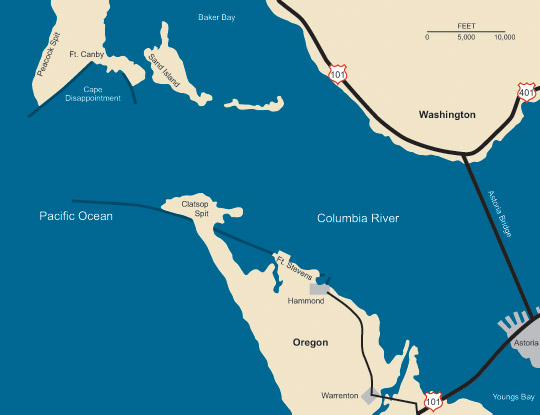
Graphic illustration map of Baker BayBaker Bay is a shallow body of water about 15 miles square, near the mouth of the Columbia River. The bay is separated from the river by Sand Island, a low-lying sand bar only a few feet above high tide level.

The bay houses wharves, floats, ramps, and berths, for fishing craft, barges and tow-boats. The small-boat basin and protecting breakwater provides moorings for numerous fishing and recreational craft year-round. The facilities are considered adequate for existing commerce.

Project Description
West Channel
Channel is 2,000 feet long, 200 feet wide, 16 feet deep
Thence A Channels is 2.5 miles long, 150 feet wide, 16 feet

East Channel
Channel is 4 miles long, 200 feet wide, 10 feet deep

At Ilwaco, Wash. is a 20-acre mooring basin 10 to 12 feet deep, protected by breakwaters.
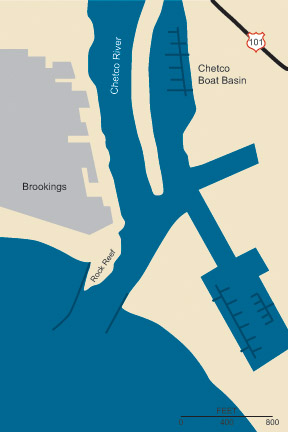
 

Graphic illustration map of Chetco RiverThe Chetco River flows into the Pacific Ocean at Brookings, Ore., 300 miles south of the mouth of the Columbia River and 345 miles north of San Francisco Bay.

The Chetco River rises in the Siskiyou Mountains of Oregon at an elevation of 4,000 feet, flows about 51 miles in a circuitous route before emptying into the Pacific Ocean.

The jetties, completed in 1957, and authorized dredging provide channel stabilization over the bar at the mouth of the Chetco River. Rock pinnacles and an abandoned bridge were removed in 1959. Modifications authorized in 1965 and completed in 1969 included an entrance channel 14 feet deep and 120 feet wide, increasing the elevation of the north jetty and extending it 450 feet. Construction of a protective dike, turning basin and small boat access channel was completed in 1970.

The Port of Brookings has two large boat basins, one for commercial fishing boats and the other for sport boats, and a public boat launching ramp. There are four fish receiving docks and a sea-going barge dock for lumber loading and storage, as well as a U.S. Coast Guard Station and a privately owned marina.

Navigation channel is 14 feet long and 120 feet deep.
Turning basin is 650 feet long, 250 feet wide, 14 feet deep.
Commercial boat basin access is 200 feet long, 100 feet wide, 12 feet deep.

Project Description
North Jetty is 1,350 feet long
South Jetty is 1,250 feet long
Protective dike is 1,800 feet long and 18 feet high
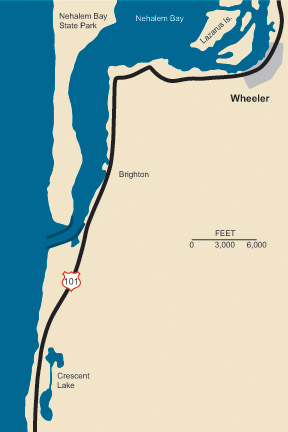
Graphic illustration map of Nehalem River and BayNehalem Bay is located 40 miles south of the Columbia River.

USACE constructed two jetties to stabilize the channel across the ocean bar at Nehalem Bay's entrance. The north jetty was built in 1918, to a length of 3,890 feet; the south jetty, built in 1916, was 4,950 feet long.

The structures were rehabilitated in 1981 and 1982 after decades of strong water and wave action removed large boulders and underwater currents displaced smaller stones. Corps contractors placed more than 347,000 tons of rock at the tips of both jetties. The boulders used in the repairs weighed more than 40 tons each – at the time, the largest ever placed on an Oregon jetty.


Project Description
North Jetty is 3,890 feet long.
South Jetty is 4,950 feet long.

Tillamook Bay is on the Oregon coast, 50 miles south of the Columbia River.
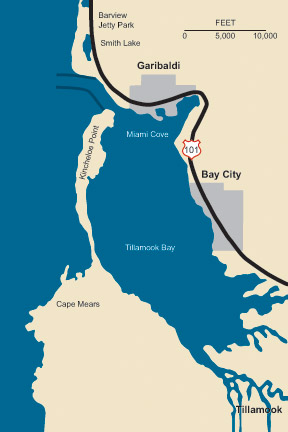
Graphic illustration map of Tillamook BayThe Army Corps of Engineers owns and maintains two jetties at Tillamook Bay’s entrance. The north jetty was constructed first in 1914 with south jetty construction beginning decades later in 1969. The Corps has made repairs to both jetties due to damage from the Pacific Ocean’s powerful waves continually smashing against them.

The north jetty was reconstructed and extended it to its full, authorized 5,700-foot length in 1931. In 2004, The Corps constructed a revetment to help prevent shoreline erosion and protect the vulnerable north jetty root. Corps contractors rebuilt the north jetty head in 2010, stabilizing the jetty at 5,213 feet. The repaired head is broader, higher and more substantial to withstand the powerful waves. The stones used for the repairs weigh between 25 to 50 tons each.

The south jetty was authorized in 1965 with completion of the first segment in 1971. The Corps completed the second segment in 1974 and the third and final segment in 1979. The 1,500-foot third segment brought the south jetty to its full authorized length of 8,000 feet.

USACE maintains an 18-foot-deep channel over the ocean bar at the entrance to Tillamook Bay; an 18-foot-deep, 200-foot-wide, three-mile-long channel to Miami Cove; a turning basin at Miami Cove; and a 12-foot-deep access channel to the Garibaldi small-boat basin. The Corps’ navigation authority includes protection of Bayocean Peninsula to preserve the present entrance channel to the bay. For that purpose, a 1.4-mile-long dike was constructed to close a breach in the peninsula between Pitcher Point and the abandoned town of Bayocean. The channel to Miami Cove was completed in 1927, the Bayocean dike in 1956, and the small-boat basin of Garibaldi in 1958. The 18-foot channel to Miami Cove is inactive due to a mill closure.

Project Description
Entrance:
 Channel is 5,000 feet long, 18 feet deep, and has no prescribed width.
 North Jetty is 5,213 feet long.
 South Jetty is 7,094 feet long.

From deep water in the bay to Miami Cove:
 Channel is 3 miles long, 200 feet wide, and 18 feet deep.
 Turning basin is 2,500 feet long, 500 feet wide, and 18 feet deep (currently inactive).

Garibaldi:
 Small boat basin is 12 feet deep.
 Approach and channel is 12 feet deep.

Bay Ocean Peninsula:
A sand- and rock-filled dike extends 1.4 miles between Pitcher Point and the town of Bay Ocean.

Skipanon Channel is a tidal waterway extending south 2.7 miles from deep water in Columbia River. The channel enters the Columbia River about 10 miles above the Columbia River's entrance bar, and 4 miles below Astoria, Ore.

The Skipanon Channel serves the city of Warrenton, Ore., which owns a 300-foot public wharf. A small-boat basin has facilities for numerous fishing and recreation craft.

The channel from the Columbia River to the railroad bridge at Warrenton is 1.8 miles long, 200 feet wide, and 30 feet deep.
The turning basin is 30 feet deep.
The mooring basin is 12 feet deep.

Above the railroad bridge, the channel is 4,500 feet long, 40 feet wide (with increased widths at log dumps and terminals) and 6 feet deep.

The federal navigation channel at the mouth of the Columbia River is six miles long and lies between two jetties. It was first authorized in 1884.

The Corps operates and maintains three jetties and the navigation channel that serves as the border between Washington and Oregon. The north jetty, built from 1913 to 1917, is 2.5 miles long. Jetty “A” was built in 1939 and is 0.3 miles long. The north jetty and jetty “A” are on the Washington side of the mouth. South jetty, built between 1885 and 1895, is 6.6 miles long and on the Oregon side of the mouth.

Many areas of each structure have been severely damaged due to the extreme waves of the Pacific Ocean interacting with the Columbia River. The structures are routinely exposed to ocean waves ranging from 10 to 20 feet high. Increased storm activity and the loss of sand shoal material upon which they are built have taken a toll on the structural integrity of the jetties. The Corps is working to restore the system to acceptable levels of reliability.

Previously interim repairs were completed for the North and South Jetties from fiscal year 2005 to 2007. The North Jetty interim repair was completed in November 2005 with 58,000 tons of stone placed over 3,000 feet. The South Jetty interim repair was completed in September of 2007 with 168,000 tons placed over 5,300 feet. South Jetty Reach A was finished in 2006 with 82,000 tons of stone placed over 2,200 feet and Reach B was completed in 2007 with 86,000 tons placed over 3,100 feet. Jetty A rehabilitation was completed in 2016.

The Corps completed the Columbia River Channel Improvements Project in November 2010. The project deepened the Columbia River by three feet, to 43 feet along a 103-mile stretch of river from the Pacific Ocean to Portland, Ore. The project took 20 years to complete and was a collaborative effort between the Corps and six lower Columbia River ports (Portland, Vancouver, Kalama, St. Helens, Longview and Woodland). The project improved navigation by deepening the channel to accommodate the current fleet of international bulk cargo and container ships and to improve the condition of the Columbia River estuary through the completion of other environmental restoration projects.

The navigation channel is important to the regional and national economy. The Port of Portland estimates more than 40,000 jobs along the lower Columbia River are dependent upon seaport activity. Seaport activity in the regions of the lower Columbia generates $208 million in state and local tax revenue and contributes 10 percent toward the state of Oregon’s gross product. About 1,000 firms export goods via the lower Columbia River and all of these goods must exit the Mouth of the Columbia River.

The Columbia River bar is the second-most treacherous in the world and the most treacherous in the United States.  By maintaining the channel to its authorized depth, the work ensures safer passage for commercial and recreational vessels. 

The project can only be dredged during the calmer weather between June and early November.  Up to 5 feet of allowable over-depth dredging may be accomplished in order to ensure authorized project depth in between dredging cycles.  In some locations 1-2 feet of additional depth may be removed or otherwise disturbed during the dredging process. 

Project Description
Main Channel
Channel A (north reach) is 6 miles long, 2,000 feet wide and 55 feet deep.
Channel A (south reach) is 6 miles long, 640 feet wide and 48 feet deep.

Jetties
North Jetty is 2.5 miles long.
South Jetty is 6.6 miles long.
Spur Jetty A is 0.3 miles long.

The Old Mouth of the Cowlitz River channel at Longview, Wash. is authorized to 8 feet deep and 150 feet wide, from deep water in the Columbia River through the Old Mouth of the Cowlitz River, to a point about 3,000 feet upstream from the old harbor line.

The navigation channel supports commercial barges shipping 288,000 tons of wood chips per year. Those chips are used to produce 144,000 tons of products worth over $84 million.

The vertical plane of reference is adopted low water. The project is subject to tidal influences and annual river freshets. A large shoal regularly forms at the Old Mouth of the Cowlitz River where it meets the Columbia River. Dredging by a contract clamshell dredge is required every 2-to-3 years to allow adequate depth for commercial barge traffic.

This shoal was last dredged by the Corps in 2002 and the material was placed at an in-water site. Limited advanced maintenance width dredging outside the authorized channel width and up to 2 feet of advanced maintenance dredging below the authorized channel depth is practiced in order to maintain adequate depth for commercial barges between dredging events.

Project Description
The authorized channel is 8 feet deep and 150 feet wide, and spans from deep water in the Columbia River at Columbia River Mile 67.5 through the Old Mouth of the Cowlitz River, to a point about 3,000 feet upstream from the harbor line at the time of authorization.

Central Oregon Coast

Graphic illustration map of Depoe BayDepoe Bay is located on the Oregon coast 100 miles south of the mouth of Columbia River.

The entrance to Depoe Bay features two breakwaters to the north, an eight-foot-deep, 50-foot-wide entrance channel, an inner basin with a retaining wall on the east side of the bay and a sediment basin near the mouth of Depoe Bay Creek. The most recent improvements were completed in 1966. Facilities in the inner basin of Depoe Bay consist of landings and floats to accommodate operators of excursion and commercial fishing boats.

Facilities are considered adequate for existing commerce.

Project Description
Channel:
Two 160-foot breakwaters are at the north end of the entrance channel.
The channel is 50 feet wide and eight feet deep with additional width at the seaward end.

Boat basin:
The boat basin is 750 feet long, 390 feet wide, and eight feet deep.
There is a concrete retaining wall on the east of the boat basin.
There is also a sediment check dam and catch basin on South Depoe Creek.

Graphic illustration map of Yaquina BayYaquina Bay is on the Oregon coast, 113 miles south of the Columbia River mouth.

One of USACE’s oldest navigation projects on Oregon's coast, Yaquina includes two jetties, several channels, turning and boat basins, and a breakwater.

Yaquina’s north jetty was constructed from 1889 to 1896 to a length of 7,000 feet, extended in 1966 and repaired in 1978, 1988 and 2001. The 8,600 foot south jetty was completed in 1896 and extended 1,800 feet in 1972. Since its construction five groins have been added to the south jetty as well as an 800-foot spur jetty. A breakwater for a small-boat basin on the north shore (a timber structure 2,650 feet long) was authorized in 1946, to protect commercial fishing boats. Congress last modified the project's authorization in 1958, allowing for extending the jetties: a 40-foot-deep, 400-foot-wide entrance channel; a 30-foot-deep, 300-foot-wide bay channel leading to a turning basin at Newport; an 18-foot-deep, 200-foot-wide, 4.5-mile-long channel from Newport to Yaquina; two small-boat basins at Newport; two small-boat turning basins at Newport; and a 1,300-foot-long breakwater to protect the Newport South Beach Marina.

The marina, which provides shelter for 232 boats, is maintained by the Port of Newport to a depth of 10 feet. In 1998, sand was removed from approximately 1,000 feet of the south jetty, the jetty was sealed with rock and filter fabric, and the sand was replaced to protect public safety and prevent sand migration through the structure. In 1999, 41,217 tons of displaced jetty stone were removed from the entrance channel to alleviate dangerous navigation conditions.

At McLean Point, on north side of bay, about 2 miles from entrance, Port of Newport has two berths one 435 feet long, the second 520 feet long, capable of serving ocean-going vessels.

Port of Newport has a public wharf with 300 feet of frontage for servicing fishing boats. In addition, Port of Newport maintains 510 berths for mooring commercial and sport fishing vessels. There are several seafood companies on the bay which have their own facilities for handling fresh fish and crab. Supplies and petroleum products are readily available for small vessels.

On south side of bay about 1.2 miles above entrance, Port of Newport has constructed South Beach Marina which can handle approximately 600 pleasure craft and shallow draft fishing boats. Public facilities include public automobile and boat trailer parking, boat launching ramp, fuel dock, a fishing pier and a picnic area.

About 2.0 miles above entrance, Oregon State University, in conjunction with the Marine Science Center on 52 acres, maintains a 220-foot pier for docking large and small research vessels and a 100-foot float for docking small boats. Docking facilitates are restricted to research vessels and State of Oregon small boats.

Project Description
Entrance
North Jetty is 7,000 feet long.
South Jetty is 8,600 feet long.
Spur Jetty off South Jetty is 800 feet long.
Five groins extend out from the south jetty.
Entrance Channel is 4,280 feet long, 400 feet wide, and 40 feet deep.
Thence a channel to McLean Point is 2 miles long, 300 feet wide, and 30 feet deep.
Turning basin at McLean Point is 1,400 feet long, 900-1200 feet wide, and 30 feet deep.
Channel from River Mile 2.4 to Yaquina is 2 miles long, 200 feet wide, and 18 feet deep.

At Newport Boat Basin
Breakwater is 2,650 feet long.
Shore-wing is 400 feet long.

At South Beach Boat Basin
Two breakwaters are 1,800 and 700 feet long.
Access channel is 2,035 feet long, 100 feet wide, and 10 feet deep.


South Oregon Coast

Graphic illustration map of Coos BayCoos Bay is on the Oregon coast 200 miles south of mouth of Columbia River and 445 miles north of San Francisco Bay.

Coos Bay is about 13 miles long and 1 mile wide, with an area at high tide of about 15 square miles. The Corps maintains two jetties at the entrance: the south jetty, completed in 1928, and the north jetty, completed in 1929.

The original authorization allowed USACE to maintain the entrance channel at 45 feet deep and 700 feet wide. A modification was authorized in the fiscal year 1996 Energy and Water Development Appropriations Act, Public Law 104-46, which provided for deepening the channel by 2 feet to 47 feet from the entrance to Guano Rock at river mile 1, and to 37 feet from river mile 1 to 15. Public Law 104-46 also provided for deepening by two feet and expanding the turning basin at river mile 12 by 100 feet from 800 by 1,000 feet to 900 by 1,000 feet.

At North Bend there is a municipal dock 649 feet long, about 2,380 feet of privately owned mill docks and three oil receiving terminals.

At Coos Bay there is a privately owned dock that is open to the public, several small landings for fishing and harbor craft and three lumber docks with 1,300-foot, 576-foot, and 500-foot frontages, respectively.

In the North Spit industrial area, there is one woodchip loading facility and a smaller T-dock operated by the Port of Coos Bay.
At Eastside, on Isthmus Slough, there is a 200-foot dock.

At Empire there is a privately owned lumber dock and an oil terminal, owned by Port of Coos Bay, for receipt of petroleum products by barge. A barge slip also owned by the Port was completed in 1986.

At Charleston there are wharves, for receipt of fresh fish and shellfish and a large seafood receiving and processing plant. There are also two municipally owned small-boat basins capable of mooring 250 fishing and recreation craft. Servicing facilities for small craft are available at all facilities and public launching ramps have been constructed by private interests. A privately owned floating moorage on Joe Ney Slough has facilities for mooring about 50 fishing vessels.

At Jordan Cove area there is a dock, 248 feet long, for wood chip ships.

Coos Bay North Jetty Repair 

USACE recognizes the North Spit is a valuable resource, jetties are important for safety, and repairs will support commerce activities in the area.

The North Jetty has lost a total of 1,121 feet from the jetty’s full authorized length. Since the mid-1990's the beach adjacent to the north jetty has receded landward by hundreds of feet exposing a non-substantial part of the jetty to wave attack and scour.

The Corps is currently repairing the North Jetty, which includes reconstruction of the head, repair of the trunk and reconstruction of a portion of the root. Repairs will be complete in October 2026. With reconstruction of a portion of the root, any fill action in Log Spiral Bay (LSB) will be deferred in the short term for monitoring. The effectiveness of the rebuilt jetty root will be monitored to determine if it is managing/reducing erosion on the LSB shoreline. The Corps completed an Environmental Assessment for these repairs and has published a Finding of No Significant Impact to move forward with repairs.

Project Description
Jetties
North Jetty is 9,600 feet long
South Jetty is 3,900 feet long

Channels
From the Pacific Ocean to river mile 1 the channel is 700 feet wide and 47 feet deep.
From Coos Bay to Millington there is a channel two miles long, 150 feet wide and 22 feet deep.
From deep water in Coos Bay to Charleston the channel is 3,200 feet long, 150 feet wide and 17 feet deep.

Turning Basins
At North Bend, Ore., river mile 12 there is a turning basin which is 1,000 feet long, 800 feet wid, and 37 feet deep.
At Coalbank Slough, river mile 14.7, there is a turning basin which is 1,000 feet, 700 feet and 37 feet deep.

Graphic illustration map of Coquille RiverThe Coquille River rises in Oregon's Coast Range and flows westerly for 100 miles, emptying into the Pacific Ocean at Bandon, Ore., 225 miles south of mouth of Columbia River and 420 miles north of San Francisco Bay.

There are two jetties at the mouth of the Coquille River. The south jetty is 2,700 feet long; the north is 3,450 feet long. There is a channel 13 feet deep from the sea to a point one mile upstream from the old Coquille River lighthouse. Project authorization also calls for removing snags from the channel up to the highway bridge at Coquille. The jetties were completed in 1908 and the entrance channel in 1933. The north jetty was rebuilt in 1942, extended in 1951, and repaired in 1956. The south jetty was repaired in 1954. Restoration of the historic Coquille lighthouse was completed in 1976.

The Port of Bandon constructed a boat basin facility in conjunction with a protective breakwater and 300-foot-long entrance channel, under Section 107 authorization in 1985.

At Bandon you’ll find a privately-owned mill dock used exclusively for shipping lumber on coastwise vessels, a publicly owned wharf and a small-boat basin open to all on equal terms.
The entrance to Bandon small boat basin is 300 feet long, 100 feet wide and 13 feet deep. The access channel is 500 feet long, 50 feet wide and 13 feet deep. There is also a protective rubble mound structure.

Project Description
Jetties:
North Jetty is 3,450 feet long
South Jetty is 2,700 feet long

Channel:
The navigation channel from the Pacific Ocean to river mile 1.3 is 13 feet deep.

Project authorization also calls for removing snags from the channel up to the highway bridge at Coquille.

Port Orford Aerial ViewPort Orford is on Oregon's coast, 250 miles south of the Columbia River and 390 miles north of San Francisco Bay.

The project consists of a 550-foot extension of a locally-constructed breakwater and a 16-foot-deep mooring basin. Construction of the extension was completed in 1968 and of the mooring basin in 1971. The project authorization was modified by the Water Resources Development Act of 1992 to allow the Corps to maintain the authorized navigation channel within 50 feet of the port facility.

Port Orford's Facilities
Facilities at Port Orford includes almost three acres of dock area and two large-capacity hydraulic cranes for lifting boats from the water for repairs and/or storage and removing fish catches from boats. In fiscal year 2000 local sponsors replaced the aging wooden pile dock with a sheet pile bulkhead and backfill dock. About 150 fishing and private boats use the dock each year.

Project Description
The turning basin at Port Orford is 340 feet long, 100 feet wide, and 16 feet deep. The extension to locally constructed breakwater is 550 feet long.

Graphic illustration map of Chetco RiverThe Chetco River flows into the Pacific Ocean at Brookings, Ore., 300 miles south of the mouth of the Columbia River and 345 miles north of San Francisco Bay.

The Chetco River rises in the Siskiyou Mountains of Oregon at an elevation of 4,000 feet, flows about 51 miles in a circuitous route before emptying into the Pacific Ocean.

The jetties, completed in 1957, and authorized dredging provide channel stabilization over the bar at the mouth of the Chetco River. Rock pinnacles and an abandoned bridge were removed in 1959. Modifications authorized in 1965 and completed in 1969 included an entrance channel 14 feet deep and 120 feet wide, increasing the elevation of the north jetty and extending it 450 feet. Construction of a protective dike, turning basin and small boat access channel was completed in 1970.

The Port of Brookings has two large boat basins, one for commercial fishing boats and the other for sport boats, and a public boat launching ramp. There are four fish receiving docks and a sea-going barge dock for lumber loading and storage, as well as a U.S. Coast Guard Station and a privately owned marina.

Project Description
Navigation channel is 14 feet long and 120 feet deep.
Turning basin is 650 feet long, 250 feet wide, 14 feet deep.
Commercial boat basin access is 200 feet long, 100 feet wide, 12 feet deep.

Jetties
North Jetty is 1,350 feet long
South Jetty is 1,250 feet long
Protective dike is 1,800 feet long and 18 feet high

Graphic illustration map of Rogue River at Gold BeachThe Rogue River Harbor at Gold Beach rises in Cascade Range of southwestern Oregon, flows westerly through the Coast Range and empties into Pacific Ocean, 264 miles south of the Columbia River and 381 miles north of the San Francisco Bay.

The entrance of the Rogue River provides two jetties and a 13-foot-deep, 300-foot-wide channel from the ocean to a turning basin about one-quarter mile downstream of the state highway bridge. Construction of both jetties was completed in 1960. The north jetty was damaged in the 1964 flood and repaired in 1966. Three timber pile groins were constructed in 1984 as a five-year test of their ability to reduce shoaling of the small-boat basin access channel. In 1989, the test period was extended for five more years for two of the three test groins. The report concluded that relocation of the boat basin channel was cost effective, and in 1998, in cooperation with the Port of Gold beach, the boat basin channel was relocated approximately 1,000 feet upstream to a new opening in the breakwater provided by the Port of Gold Beach.

There are various landings for fishing and recreational craft. At Wedderburn, across river from Gold Beach, is a facility to accommodate excursion passengers and small freight items destined for various private landings between Wedderburn and Agness, Ore. Facilities considered adequate for existing commerce.

Project Description
 

Jetties
North Jetty is 3,300 feet long.
South Jetty is 3,400 feet long.

Other Features
A channel from the entrance of the Rogue River at the ocean to river mile 0+30 is 300 feet wide and 13 feet deep.
There is a turning basin 650 feet long, 500 feet wide, and 13 feet deep.
There is also a north shore bank protection structure.
The Gold Beach Boat Basin has an access channel that is 2,100 feet long, 100 feet wide, and 10 feet deep.
The turning basin is 600 feet long, 150 feet wide, and 10 feet deep.