What is NEPA? NEPA requires federal agencies to consider environmental impacts of their actions in decision making. It is important to emphasize that a federal decision cannot be made until after the environmental review process is complete. Federal agencies’ analyses are published in a Draft EIS for public review and comment. Once the public’s comments have been reviewed, federal agencies prepare a Final EIS.
Per NEPA, an EIS assessing impacts of the proposed project on the quality of the human environment will be provided to the public for review and comment. The public will be notified when opportunities for comment arise. The Citizen's Guide to NEPA explains this law and how to effectively submit your input.
Project Details: The proposal is a 99.5-mile electrical transmission line from The Dalles to Portland, OR. The proposal includes work in uplands, in/under the Columbia River, under Oregon Slough, under Columbia Slough, and under the Willamette River. The proposed alignment within the Columbia River is from approximately River Mile (RM) 190 near The Dalles to approximate RM 106 near Portland, OR. The proposed transmission line would interconnect with the existing Bonneville Power Administration (BPA) Big Eddy 500-kV alternating current (AC) substation, located in The Dalles, OR and the existing Portland General Electric (PGE) Harborton 230-kV AC substation in Portland, OR. The proposed alignment would run through Wasco, Hood River, and Multnomah counties in Oregon, and Klickitat, Skamania, and Clark counties in Washington.
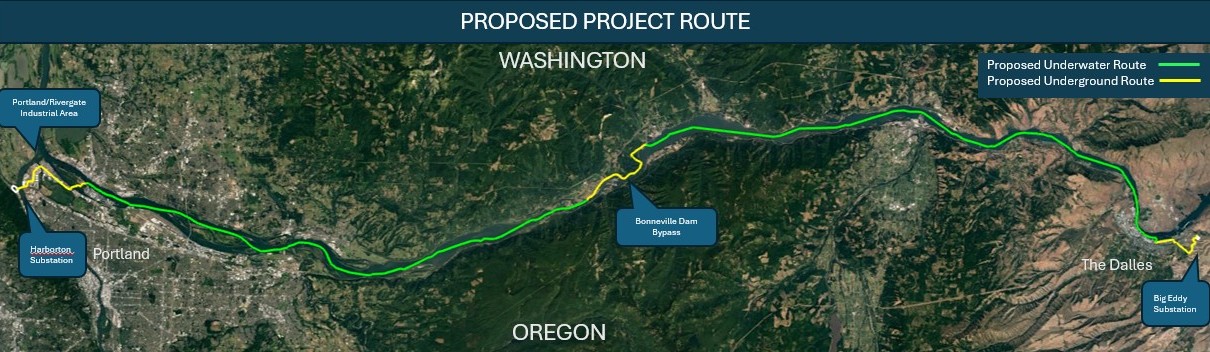
Proposed Project Route
The proposed work would include:
Install 78.9 miles of 12-inch HVDC cable bundle buried in the bed of the Columbia River via hydroplow methods. The cable bundle would be installed at a planned depth in the bed of the river 10 to 15 feet below the mudline. Where the cable bundle crosses the navigation channel prism below Bonneville Dam, the cable bundle would be installed to an elevation of at least -34 feet Columbia River Datum/Mean Pool Elevation. Hydroplow installation would excavate and redeposit as much as 305,100 cubic yards (cy) of sediment in the Columbia River.
Install four (4) temporary, three-sided sheet pile wet cofferdams measuring 70 feet wide by 300 feet long to isolate the land-to-water transition areas. Land-to-water horizontal directional drilling (HDD) in the Columbia River would occur at The Dalles, OR, near Stevenson, WA, near North Bonneville, WA, and near Portland, OR. The applicant would remove up to 26,000 cy of riverbed substrate using a clamshell dredge from inside the cofferdams (6,500 cy each). Upon completion of HDD activities, the dredged material would be discharged within the wet cofferdam and the wet cofferdam removed.
Discharge up to 7,500 cy of rock or articulated concrete blocks in the Columbia River over 0.97 acres for cable protection in areas where the cable would be buried less than 5 feet deep in river substrate due to utility conflicts, or potential substrate limitations. The cable protection footprint would be up to 8 feet wide with a total length of 2.4 miles.
Utilize HDD to install the cable bundle approximately 2,800 feet at elevation -95 feet NAVD88 (-90 feet CRD) under Oregon Slough (Columbia River south of Hayden Island).
Utilize HDD for two 30-inch bores for approximately 2,000 feet at minimum elevation of -50 feet NAVD88 below the Columbia Slough and wetlands and approximately 2,450 feet at minimum elevation of -100 feet NAVD88 (-95 feet CRD) below the Willamette River to install two HVAC cables.
Temporarily impact (excavation and backfill) 40-square feet of palustrine emergent wetland near Stevenson, WA to facilitate open-trench installation of the cable bundle along WA State Road 14.
Install HVDC cables within The Dalles Levee prism.